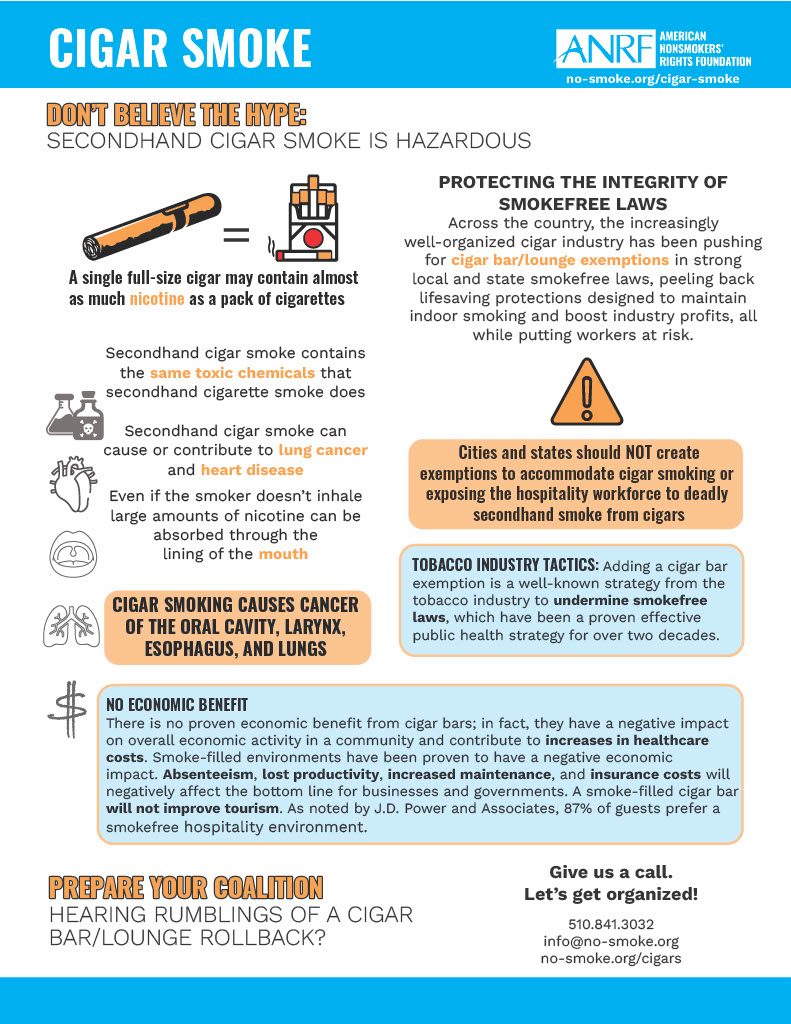
Cities and states should NOT create exemptions to accommodate cigar smoking or re-exposing the hospitality workforce to deadly secondhand smoke from cigars.
Protecting the Integrity of Smokefree Laws

Click to read latest news on cigar industry threats.
Across the country, the increasingly well-organized cigar industry has been pushing for cigar bar/lounge exemptions in strong local and state smokefree laws, peeling back lifesaving protections designed to maintain indoor smoking and boost industry profits, all while putting workers at risk. The cigar industry strategy is to claim that cigar bars only cater to a select few, but the reality is that they renormalize smoking, have broad marketing, and chip away at smokefree workplace protections. Often these spaces become smoking lounges for other products, including hookah, marijuana, and cigarettes, which expose staff, patrons, and entertainers to secondhand smoke. ‘Cigar lounge’ is a misnomer as these venues are typically bars, with only a small percentage of revenue derived from cigar sales. The industry pushes for low sales thresholds and weak provisions that allow a wide range of bars, nightclubs, and music venues to operate with indoor smoking. When a ‘cigar lounge’ is located in a mixed-use building, secondhand smoke seeps into adjoining offices, housing, and other businesses thereby exposing workers and patrons to the hazardous secondhand cigar smoke. Cigar bar exemptions are also used by the casino industry to create smoking areas on the gaming floor, creating an unnecessary and unfair loophole to smokefree workplace laws.
What to Expect and How to Fight Back
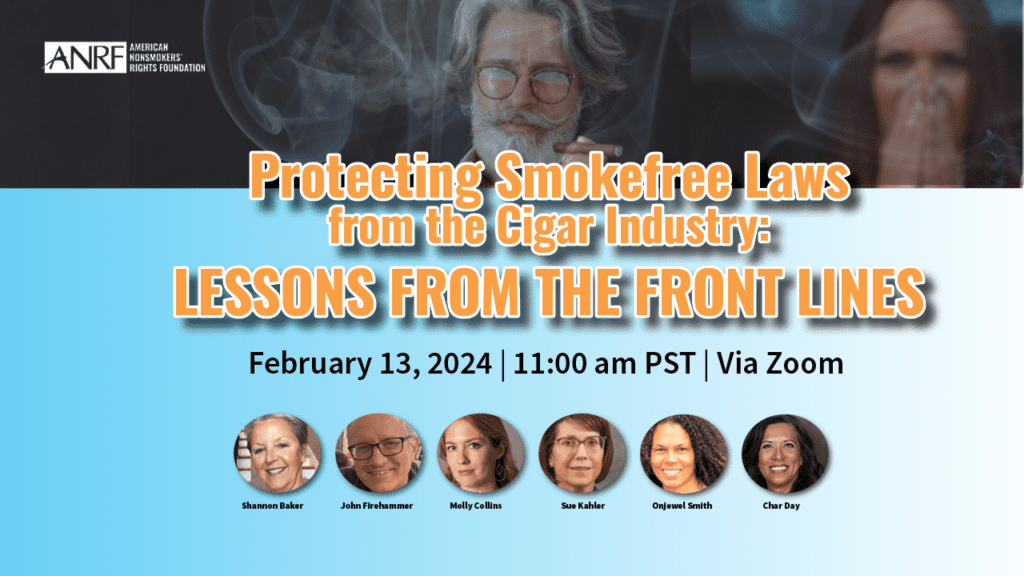
The good news: advocates at the local and state level are organizing and fighting back to protect their popular and life-saving smokefree laws. “Protecting Smokefree Laws from the Cigar Industry: Lessons From the Frontline” webinar features on the ground examples of the most compelling arguments and how advocates took action to protect smokefree indoor air rules in this webinar recording. You’ll hear from those on the front lines in Wisconsin, North Dakota, Montana, and Kentucky as they share their successes and losses against the cigar industry on the smokefree front. To access the full webinar recording and presentation slides, one must purchase ANR Foundation’s Professional Access.
Prepare Your Coalition
Hearing rumblings of a cigar bar/lounge rollback? Give us a call – let’s get organized! Download our cigar smoke one pager and Cigar Exemption Arguments and Responses here.

CIGARS AND CIGAR BARS ARE NOT A GOOD OPTION
A single full-size cigar may contain almost as much nicotine as a pack of cigarettes. Even if the smoker doesn’t inhale, large amounts of nicotine can be absorbed through the lining of the mouth.
SMOKE IS SMOKE: The American Society of Heating, Refrigerating and Air-Conditioning Engineers (ASHRAE) specifically does “not prescribe ventilation rates or claim to provide acceptable indoor air quality in smoking areas” because “the only means to avoid health effects and eliminate indoor environmental tobacco smoke exposure is to ban all smoking activity inside and near buildings.” This includes cigar smoking.
NO ECONOMIC BENEFIT: There is no proven economic benefit from cigar bars; in fact, they have a negative impact on overall economic activity in a community and contribute to increases in healthcare costs. Smoke-filled environments have been proven to have a negative economic impact. Absenteeism, lost productivity, increased maintenance, and insurance costs will negatively affect the bottom line for businesses and governments. A smoke-filled cigar bar will not improve tourism. As noted by J.D. Power and Associates, 87% of guests prefer a smoke-free hospitality environment.
Very few cigar bars pay living wages. The average wage for a cigar bar employee is $24,000.
EXEMPTIONS THREATEN HEALTH: Granting a cigar bar exemption could encourage costly lawsuits as it threatens equal protections for all workers. Adding an exemption for cigar bars removes the comprehensive protections around smokefree indoor air and opens a community up to potential expensive legal challenges.
STRONG POLICIES ARE BEST: Smokefree policy is strongest when it is comprehensive. Comprehensive smokefree policies have been found to help people quit smoking and reduce hospital admissions for heart attacks and stroke. Only a completely comprehensive law reduces heart attacks, lung cancer, and hospitalizations for chronic obstructive pulmonary disease (COPD), thereby saving lives and healthcare dollars. Each exemption puts workers at risk, and no one deserves to work in a smoke or aerosol filled environment. Secondhand smoke places employees at risk of cardiovascular disease and cancer. This will also impact anyone else who must come into contact with the business, such as delivery people, vendors, and other contractors.
Allowing cigar bars to sell food and beverage could drastically increase the number of establishments where residents and employees are exposed to tobacco smoke, where currently there are no public places that allow tobacco smoking indoors.
TOBACCO INDUSTRY TACTICS: Adding a cigar bar exemption is a well-known strategy from the tobacco industry to undermine smokefree laws, which have been a proven effective public health strategy for over two decades. This past year, several cities and states have seen similar policies advance and be rejected. This includes Montana, North Dakota, and Atlanta. States and cities recognize the importance of protecting a decades-long successful strategy of protecting the public by keeping indoor spaces smokefree.
HEALTH INEQUALITY: Cigar bars are likely to have an inequitable impact on smoking initiation and consumption. While the perception is that cigars are consumed by older men, the use of flavorings in some cigar brands and the fact that they are commonly sold as a single stick make them especially appealing to young female college students of color. Research also indicates that exposure to tobacco marketing in bars has increased non-smoking college students to try tobacco products for the first time.
Black adults consume cigars at higher rates than the average adult population (8% compared to 4.9%). This population already experiences higher levels of cancer, cardiovascular disease, and asthma — diseases exacerbated by smoking. Those who smoke cigars as well as other tobacco products are less likely to quit than those who smoke just one product.
Helpful tools from our partners
Truth Initiative: https://truthinitiative.org/research-resources/traditional-tobacco-products/cigars-facts-stats-and-regulations
Check out our blog posts on cigar industry interference and rollback threats:
https://no-smoke.org/rollback-alert-cigar-industry-threatens-strong-popular-smokefree-laws/
https://no-smoke.org/anr-responds-to-borgatas-planned-cigar-snob-event/
Resources from CDC-OSH
Addressing Use of Cigars
Steps people in government and communities can take to prevent the use of cigars and to help people quit
Cigar Use in the United States
Demographic data describing how pervasive cigar use is across the country, especially among youth
Cigars
A fact sheet on what constitutes a cigar and the health effects associated with cigar use and secondhand smoke exposure
Cigars Are a Public Health Problem
How the tobacco industry designs and markets cigars to encourage use, especially among certain populations
Cigars – Health Effects and Trends
A Table of Contents with links to chapters of the National Cancer Institute’s monograph on the health effects of cigar use and secondhand smoke exposure
Findings from the Population Assessment of Tobacco and Health (PATH) Study
A 2017 study that examined the different motivating and behavioral factors for use by cigar type
RELEVANT RESEARCH:
Check out the supplement on cigars in the Nicotine & Tobacco Research journal.
Other studies:
Crankshaw, E.; Hein, R.; Fajobi, O.; Lee, J., “Correlates of blunt use frequency and blunt/cigar dual use among youth and young adults,” Substance Use and Misuse 61(2): 161-167, [February] 2026.
Ranney, L.M.; Jebai, R.; Jetsupphasuk, M.; Clark, S.A.; Jarman, K.L.; Kowitt, S.D.; Thrasher, J.F.; Goldstein, A.O.; Cornacchione, J.R., “Perceived effectiveness of cigar warnings among young people in the United States,” American Journal of Preventive Medicine [Online ahead of print], January 28, 2026.
Kowitt, S.D.; Clark, S.A.; Jetsupphasuk, M.; Jarman, K.L.; Jebai, R.; Goldstein, A.O.; Ross, J.C.; Ranney, L.M., “Examining the influence of descriptors used to market unflavoured cigarillos: an experiment with a sample of youth and young adults from the USA,” Tobacco Control [Online ahead of print], January 8, 2026.
Mantey, D.S.; Ruleman, A.M.; Üsküp, D.K.; Twitty, D.; Montgomery, L., “Trends in blunt smoking among adults in the United States, 2015-2022,” Addictive Behaviors 172: 108507, January 2026.
Arnold, M.J.; Leavens, E.L.S.; Sanderson Cox, L.; Brown, A.; Mayo, M.S.; Baldwin, N.L.; Nguyen, T.A.; Nollen, N.L., “Perceptions of a menthol cigarette and flavored cigar ban among Black and White adults who smoke menthol cigarettes, United States, 2024,” Public Health Reports [Online ahead of print], December 12, 2025.
Xu, X.; Homsi, G.; Liu, S.T.; Gaber, J.M.; Inyang, N.A.; Rostron, B.L.; Nagler, C.F.; Nonnemaker, J., “Annual U.S. healthcare expenditures attributable to cigar smoking between 2001 and 2018, overall and by payer,” PLoS One 20(12): e0337757, December 1, 2025.
Buszkiewicz, J.H.; Patel, A.; Cook, S.; Fleischer, N.L., “Longitudinal association of exclusive and dual use of menthol cigarettes and flavored cigars with cigarette and cigar smoking cessation among U.S. adults – population assessment of tobacco and health study waves 1-5 (2013-2019),” Drug and Alcohol Dependence 276: 112906, November 1, 2025.
Crump, A.A.; Amick, B.C.; Landes, R.D.; Brown, C.C.; Porter, A.; Fairman, B.F., “Perceived tobacco accessibility and cigar initiation: exploring racial and ethnic differences,” Tobacco Use Insights [Online ahead of print], September 27, 2025.
Zhang, X.; Dong, T.; Chen, D.; Sun, H.; Xu, A.; Wang, C.; Li, D.; Cai, J.; Bu, L.; Zhang, K.; Chen, H., “Unraveling flavor formation mechanism of cigar smoke through volatile compounds in cigar smoke and potential precursors in cigar tobacco,” Frontiers in Plant Science 16: 1672119, September 25, 2025.
Feinstein, M.J.P.; Erath, T.G.; Thrailkill, E.A.; DeSarno, M.J.; Medina, N.; Freitas-Lemos, R.; Higgins, S.T.; Klemperer, E.M., “Investigating the substitutability of little cigars/cigarillos, e-cigarettes, and other noncombusted tobacco products for cigarettes using the experimental tobacco marketplace,” Experimental and Clinical Psychopharmacology [Online ahead of print], September 8, 2025.
Johnson, T.O.; Satybaldiyeva, N.; Schleicher, N.C.; Hrywna, M.; Henriksen, L., “Cigarette and cigarillo ads promote ‘flavour’ in a US state that prohibits flavoured tobacco sales,” Tobacco Control [Online ahead of print], August 21, 2025.
Lonn, A.; Dewhirst, T.; Lee, W.B., “Behind the smoke: using authenticity to romanticise cigars,” Tobacco Control [Online ahead of print], June 6, 2025.
Hać, P.; Okabayashi, S.; Tsuboi, M.; Cieślik, B.M.; Konieczka, P., “Assessment of toxicity associated with inhalation of potentially toxic elements present in combustible tobacco products: cigars, pipe tobacco, bidis and cigarettes – an evaluation of risk assessment issues,” Toxicology 514: 154092, June 2025.
Inyang, N.A.; Loomis, B.R.; Nagler, C.F.; Coats, E.M.; Saba, C.; Saunders, M.; Liu, S.T., “Receipt and use of prohibited free samples of tobacco products among US adults who use cigarettes, cigars and smokeless tobacco, 2020,” Tobacco Control 34(3): 397-402, May 2025.
Audrain-McGovern, J.; Manikandan, D.; Koita, F.; Klapec, O.; Pickworth, W.B.; Stone, M.D., “Effect of sweet flavouring on the rewarding and reinforcing value of cigarillo among young adults,” Tobacco Control , May 2025.
Ntansah, C.A.; Popova, L.; Hardin, J.W.; Kim, M.; Sterling, K.L.; Reynolds, R.M.; Hackworth, E.E.; Ashley, D.L.; Henderson, K.C.; Yang, B.; Thrasher, J.F., “Assessing the impact of messages about reduced nicotine cigar products among people who use little cigar and cigarillo: insights from a discrete choice experiment,” Nicotine and Tobacco Research [Online ahead of print], January 17, 2025.
Tasdighi, E.; Yao, Z.; Jha, K.K.; Dardari, Z.A.; Osuji, N.; Rajan, T.; Boakye, E.; Rodriguez, C.J.; Matsushita, K.; Simonsick, E.M.; Lima, J.A.C.; Widome, R.; Cohen, D.; Appel, L.J.; Khera, A.; Hall, M.E.; Judd, S.; Cole, S.A.; Ramachandran, V.S.; Benjamin, E.J.; Bhatnagar, A.; DeFilippis, A.P.; Blaha, M.J., “Cigar, pipe, and smokeless tobacco use and cardiovascular outcomes from cross cohort collaboration,” JAMA Network Open 8(1): e2453987, January 13, 2025.
Carter, C.C.; Binns, S.; Emery, S.L.; Kostygina, G., “Analysis of cigar marketing expenditures by product category, placement strategy and geolocation in the USA, from 2017 to 2022,” Tobacco Control [Online ahead of print], October 17, 2024.
Sanchez, J.I.; Fong, R.S.; Hampilos, K.; Cooper, Z.D.; Middlekauff, H.R., “Blunt talk on “blunts”: the increasingly popular tobacco product that is potentially exacerbating tobacco-related health disparities,” Journal of General Internal Medicine [Online ahead of print], September 23, 2024.
Guillory, J.; Curry, L.; Homsi, G.; Saunders, M.; Henes, A.; MacMonegle, A.; Nonnemaker, J.; Sanders, E.C.; Mekos, D.; Wall Vigorita, M.; Budenz, A., “Predictors of cigar, cigarillo, and little cigar initiation among hip hop-identifying youth,” Substance Use and Misuse 60(1): 44-53, September 18, 2024.
Jensen, J.K.; Ganz, O.; Tomaino, M.; Glasser, A.M.; Sterling, K.; Delnevo, C.D.; Bover Manderski, M.T., “Patterns of blunt and cigar use in the United States, 2015-2019,” Nicotine and Tobacco Research [Online ahead of print], September 5, 2024.
Mantey, D.S.; Montgomery, L.; Chen, B.; Omega-Njemnobi, O.; Harrell, M.B., “Blunt smoking during emerging adulthood: characterizing transitions in cannabis and cigar co-use among a diverse cohort in Texas,” Addictive Behaviors 156: 108062, September 2024.
Kowitt, S.D.; Clark, S.A.; Glaser, O.; Jetsupphasuk, M.; Jarman, K.L.; Goldstein, A.O.; Thrasher, J.F.; Ranney, L.M.; Cornacchione Ross, J., “Examining the influence of cigar and cannabis co-marketing on packaging perceptions: an experiment with a sample of US youth,” Addictive Behaviors 158: 108126, August 5, 2024.
Buszkiewicz, J.H.; Mok, Y.; Mukerjee, R.; Fleischer, N.L.; Meza, R.; Jeon, J., “Cross-sectional patterns and longitudinal transitions of unflavored and flavored cigar use without and with cigarettes among United States adults,” Preventive Medicine 185: 108027, August 2024.
Levy, D.T.; Cadham, C.; Mok, Y.; Travis, N.; Buszkiewicz, J.H.; Jeon, J.; Fleischer, N.L.; Meza, R., “The public health impact of a ban on flavored cigars: a decision-theoretic policy framework,” Nicotine and Tobacco Research, [Online ahead of print], July 13, 2024.
Kleber, S.; Philips, R.; Goldstein, A.O., “Reports of tobacco sales, sponsorships, and policies at professional golf tournaments,” Nicotine and Tobacco Research [Online ahead of print], March 18, 2024.
Diaz, M.C.; Yoon, S.N.; Donovan, E.; Akbar, M.; Schillo, B.A., “The effect of state and local flavored cigar sales restrictions, on retail sales of large cigars, cigarillos and little cigars in Massachusetts, California, Illinois, and New York,” Nicotine and Tobacco Research 26(2): 169–176, February 2024.
Cook, S.; Buskiewicz, J.; Levy, D.T.; Meza, R.; Fleischer, N.L., “Association between cigar use, with and without cigarettes, and incident diagnosed COPD: a longitudinal cohort study,” Respiratory Research 25(1): 13, January 4, 2024.
Ji, H.; Jin, Z.; Fenton, L.; Slone, S.;, “Evaluation of six aromatic amines in the mainstream smoke of commercial cigars,” Chemical Research in Toxicology 36(12): 2001-2009, December 18, 2023.
Vargees, C.; Stroup, A.M.; Niznik, T.; Dunn, D.; Wyatt, R.; Hoetger, C.; Taleb, Z.B.; Cohn, A.M.; Cobb, C.O.; Fetterman, J.L., “Patterns of use, perceptions, and cardiopulmonary health risks of cigar products: a systematic review,” BMC Public Health 23(1): 2357, November 28, 2023.
Lin, K.; Wallis, C.; Wong, E.M.; Edwards, P.; Cole, A.; Van Winkle, L.; Wexler, A.S., “Heterogeneous deposition of regular and mentholated little cigar smoke in the lungs of Sprague-Dawley rats,” Particle and Fibre Toxicology 20(1): 42, November 6, 2023.
Kong, A.Y.; Ganz, O.; Villanti, A.C., “Exploring the presence and type of premium cigar retailers with neighborhood sociodemographic correlates in the United States, 2019-2021,” Nicotine and Tobacco Research 25(Suppl_1): S65-S68, July 28, 2023.
Ozga, J.E.; Smiley, S.L.; Hart, J.L.; Popova, L.; Stanton, C.A., “Premium cigar festivals: a potential target for marketing restrictions,” Nicotine and Tobacco Research 25(Supplement 1): S81–S83, July 28, 2023.
Levy, D.T.; Meza, R.; Yuan, Z.; et al., “Public health impact of a US ban on menthol in cigarettes and cigars: a simulation study,” Tobacco Control 32(e1): 37-44, April 1, 2023.
Repace, J.; Ott, W.; Klepeis, N., “Indoor Air Pollution From Cigar Smoke” In: Cigars: Health Effects and Trends. Tobacco Control Monograph No. 9. Bethesda, MD: U.S. Department of Health and Human Services, National Institutes of Health, National Cancer Institute. NIH Pub. No. 98-4302, February 1998. Last updated September 24, 2020.
Corey, C.G.; Holder-Hayes, E.; Nguyen, A.B.; Delnevo, C.D.; Rostron, B.L.; Bansal-Travers, M.; Kimmel, H.L.; Koblitz, A.; Lambert, E.; Pearson, J.L.; Sharma, E.; Tworek, C.; Hyland, A.J.; Conway, K.P.; Ambrose, B.K.; Borek, N., “US adult cigar smoking patterns, purchasing behaviors, and reasons for use according to cigar type: findings from the Population Assessment of Tobacco and Health (PATH) Study, 2013-2014,” Nicotine and Tobacco Research 20(12): 1457-1466, November 15, 2018.