
Remembering an ANR Smokefree Hero

Lewis McTush brought to light a simple truth: the blues cannot survive without the people who play it. And the people who play it were being slowly, quietly poisoned.
Known to everyone in the music world fondly as “Mr. McTush,” he spent years as a fixture in Atlanta’s entertainment industry, working in music promotion and building deep roots in the blues community. He watched musicians night after night take the stage in smoke-filled clubs and bars, breathing in clouds of secondhand smoke as the price of doing their life’s work. He watched gifted artists get sick. He watched careers cut short. And eventually, he decided he wasn’t going to watch anymore.
He was a proud member of the Atlanta Blues Society, an organization he helped steer toward a bold stance: it would only hold its monthly events in smokefree venues. It was a quiet but powerful declaration that protecting musicians wasn’t optional; it was a precondition for everything else.
His work in music promotion had given him a rare vantage point. He understood the economics and culture of live performance. He knew venue owners, booking agents, artists, and fans. And he understood something many outside the industry didn’t: that musicians were workers, with all the occupational health rights that implied. Rights that were routinely denied them the moment they walked into a club.
He saw that musicians’ livelihoods depend on performing live, night after night, in the very venues that were making them sick. The more successful you were as a working musician, the more hours you logged breathing toxic air. Success and harm were bound together, and that, McTush argued, was exactly backwards. “We as entertainers have become victims of our own success,” McTush said. “Breathing in these toxic vapors is the one link that we all have in common and explains why it is we are all so sick.”
Mr. McTush’s advocacy was a years-long effort; he networked, talked to many people and helped build smokefree coalitions across Georgia and beyond. He founded and led two initiatives that became central to that work: Smokefree Rights for All and Entertainers Speaking Out. Both drew directly on his industry relationships, mobilizing artists and entertainment workers who had long suffered in silence.
His signature message was blunt and memorable: “Some call it ambiance… we call it deadly.”
ANR Southern States Strategist, Onjewel Smith, was among those who connected with Mr. McTush during one of the early attempts to launch a smokefree Atlanta campaign, an effort that required multiple starts before finally succeeding. His persistence through those setbacks was characteristic: he didn’t treat a setback as a defeat, but as part of the long arc of change.
In Georgia, McTush was an invaluable part of the smokefree coalitions that worked to pass comprehensive smokefree policies in Atlanta and Augusta. These were wins that had been years in the making and required navigating powerful opposition from the hospitality industry. Atlanta, as a major music city, had long been a gap in smokefree protections, and McTush threw himself into the work of closing that gap.
Smokefree Music Cities: Taking the Fight National
Mr. McTush’s reach extended well beyond Georgia. Through his partnership with ANR Foundation’s Smokefree Music Cities project, he carried the fight into Louisiana and Tennessee, two states with rich, beloved music traditions and significant gaps in worker protections for musicians.
In Louisiana, ANR Foundation helped co-sponsor the Baton Rouge Blues Festival in 2018, which coincided with the implementation of the smokefree East Baton Rouge law, a victory that finally protected workers in bars, clubs, and casinos. Mr. McTush’s work had helped lay the groundwork for coalitions like the one that made that win possible, by demonstrating that musicians themselves were willing to speak up.
In Tennessee, the seeds of what would later grow into Smokefree Tennessee and the Nashville ordinance campaign were being planted during the same period. Cities like Nashville (now smokefree) and Memphis remained significant gaps in smokefree protections for musicians, and Mr. McTush’s campaigns helped illuminate why that mattered, not only for worker health but for the survival of the musical traditions those cities were so proud to claim.
Protecting the Musicians; Preserving the Blues
There was a deeper argument threaded through everything Mr. McTush did, one that went beyond standard public health messaging. He cared fiercely about bringing young people into blues music, about passing on the tradition and keeping it vital. And he understood that smokefree venues weren’t just a health policy: they were an act of cultural preservation.
If you want young musicians to pursue the blues, you have to give them venues where they can breathe. If you want the next generation of audiences to discover this music, you have to welcome them into spaces that feel safe and inclusive, not choked with secondhand smoke. The connection between smokefree advocacy and the blues was, for Mr. McTush, not incidental. It was the whole point.
One of the young blues musicians Mr. McTush connected with was Jontavious Willis, a Grammy-nominee from rural Georgia. He says, “It’s a strain to perform in venues that allow smoking.” Other artists Mr. McTush brought to the cause: Little Dylan, Justin Golden, Jayy Hopp, Dee Lucas, Mike Bourne, Sean McDonald, Cam Kimbrough, and BB King’s daughter, Claudette King.
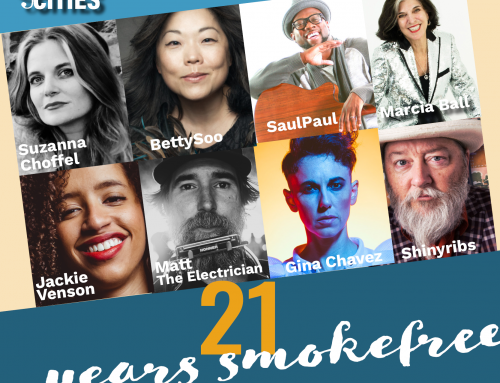
ANR Foundation produced several Smokefree Music Cities videos featuring Mr. McTush and other blues artists making this case.
These shows captured the spirit beautifully and are worth watching:
Smokefree Hero
Mr. McTush was given one of the ANR Foundation’s “Voices for Smokefree Air” awards in recognition of his work with advocates who were willing to lift their voice in relentless pursuit of smokefree air for everyone – no matter where they work. Mr. McTush was the kind of advocate ANR has always relied on: someone rooted in a community, trusted by the people most affected, willing to do the unglamorous work of coalition-building, and stubborn enough to keep going when progress stalled.
When ANR learned of his passing, in May of 2023, the loss was felt deeply. “With his distinctive voice and heart full of passion and commitment to serve his fellow artists, Lewis McTush was a tireless champion for smokefree air,” Onjewel Smith wrote. “Mr. McTush will forever be a member of the ANR/F and Smokefree Music Cities families and our fight for smokefree rights for all. We will miss him deeply.”
His Legacy Lives in Every Smokefree Venue
The fights Mr. McTush poured himself into are still being won. Atlanta is smokefree. Augusta is smokefree. Baton Rouge is smokefree. Nashville, where the preemption battles he helped spotlight eventually yielded a comprehensive ordinance in 2022, is smokefree. The musicians playing in those cities tonight are breathing cleaner air in part because of how Mr. McTush cared so much for the lives of musicians.
As ANR marks 50 years of this work in 2026, Mr. McTush’s legacy stands as a reminder that the movement has always been made of people like him: advocates who came to this fight not from a policy background but from love. Love of their community, love of their art form, love of the people around them who deserved better.
“Some call it ambiance,” he said. “We call it deadly.”
He called it out loud and clear, and we stand ready to carry this work forward.
Mr. Lewis McTush was named an ANR Smokefree Hero in recognition of his years of advocacy for smokefree music venues across Georgia, Louisiana, and Tennessee. He was the founder of Smokefree Rights for All and Entertainers Speaking Out, and a proud member of the Atlanta Blues Society. He passed away in May 2023. ANR honors his memory as part of our 50 Stories for 50 Years campaign.
Follow us on Facebook and Instagram for ANR’s 50 story updates throughout 2026, and join the conversation using #ANR50