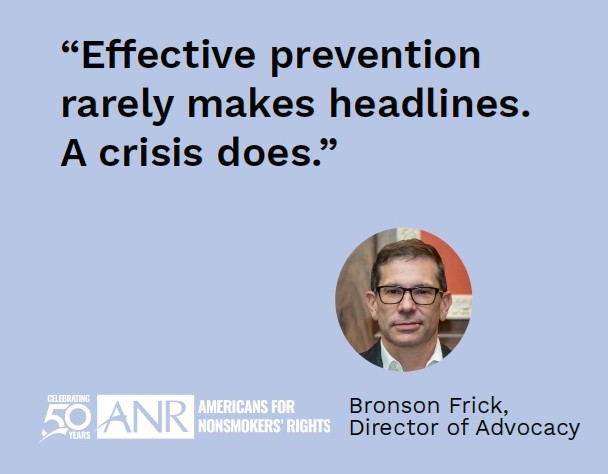

Clinton Isham, ANR Foundation Tribal Relations Consultant and Co-Founder, Reclaim Sacred Tobacco Coalition

For generations, Tribal communities have honored tobacco as a sacred medicine used in ceremony and prayer. As one of the most important plant medicines, protecting its traditional use remains a central priority for Reclaim Sacred Tobacco (RST). Our coalition works nationally to distinguish commercial tobacco from ceremonial tobacco, while also advancing Tribal-level policies that support the reclamation of ceremonial tobacco. Clinton Isham stands at the forefront of this effort, guided by what he describes as “the love for his community and his people,” which continues to inspire and sustain this work.
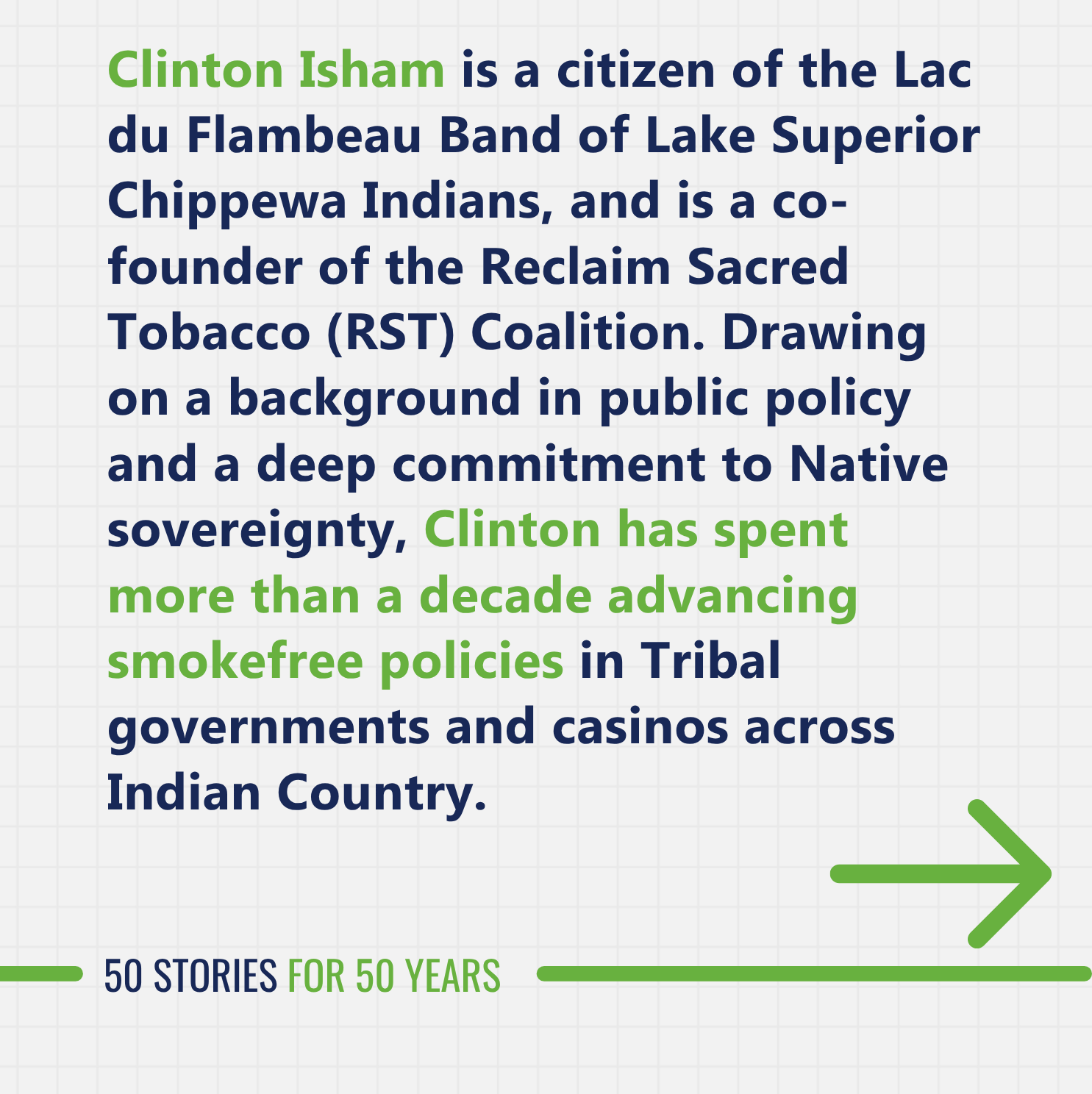
Isham is a citizen of the Lac du Flambeau Band of Lake Superior Chippewa Indians, a Tribal Relations Consultant with the ANR Foundation, and co-founder of the Reclaim Sacred Tobacco (RST) Coalition. His work advances smokefree policies in Tribal lands and casinos while centering Native sovereignty and culture with every step of the process. For more than a decade, he has been building a coalition rooted in the community it serves, moving at the pace that community sets, and embraced with terms that the Tribes defines.
“The ultimate benefit,” Isham has said, “is always restoring our medicines, restoring our tobacco, so that it can bring what it was intended to bring, health and wellness. That’s what our medicines are for.”
Commercial Tobacco and Indian Country
For decades, Big Tobacco ran targeted marketing campaigns in Indian Country, exploiting the cultural significance of traditional tobacco to normalize commercial products. The strategy was deliberate and the results devastating. Native Americans suffer some of the highest rates of lung disease, heart disease, and cancer related to commercial tobacco of any group in the United States.
The cruel irony is that tobacco itself was never the enemy. In its traditional form, it was a gift, grown and used sparingly and intentionally, and understood as medicine. Commercial tobacco, mass-produced, processed with additional chemicals to make it more addictive, is something else entirely. Part of what RST does is help communities hold onto that distinction: to name commercial tobacco as the problem while affirming the sacred role of traditional tobacco in Native life.
“We’re focusing on reclaiming medicines, reclaiming tobacco,” Isham has explained. “Our campaigns are kind of outside the box. They don’t fit within regular CDC programming or conventional programming.”
Building ANR’s Work in Indian Country
Drawing on a background in public policy and a deep commitment to Native sovereignty, Clinton led a statewide commercial tobacco prevention and control program for the 11 Tribes in Wisconsin, developing deep expertise in how smokefree policy works and doesn’t work in Tribal contexts. When he began working with ANR Foundation as a Tribal Relations Consultant, he brought that knowledge into a national organization and helped shape how ANR showed up in Indian Country.
That presence matters because ANR’s model in Tribal communities is deliberately different from how national nonprofits often engage with Native communities. Rather than arriving with ready-made campaigns and policy templates, ANR provides technical support, resources, and funding infrastructure that allows Tribes to lead their own efforts. Clinton is the relationship at the center of that model, the person who shows up at conferences, facilitates conversations between Tribes that have passed policies and Tribes that are just beginning, and helps translate between the world of public health policy and the specific realities of Tribal governance and sovereignty.
“I have 100% support from ANR Foundation,” Isham has said. “I rely on that support, and the success of RST is definitely a result of having ANR Foundation there as this national nonprofit that has worked with Tribes prior to RST.”
One of the most meaningful parts of that support, he notes, is patience. “Even though there may not be results right away, they trust that the work is getting done. The win may look different in Tribal communities and it means a lot when a non-tribal organization, non-tribal funders can trust in us to make those things happen.”
The Reclaim Sacred Tobacco Coalition
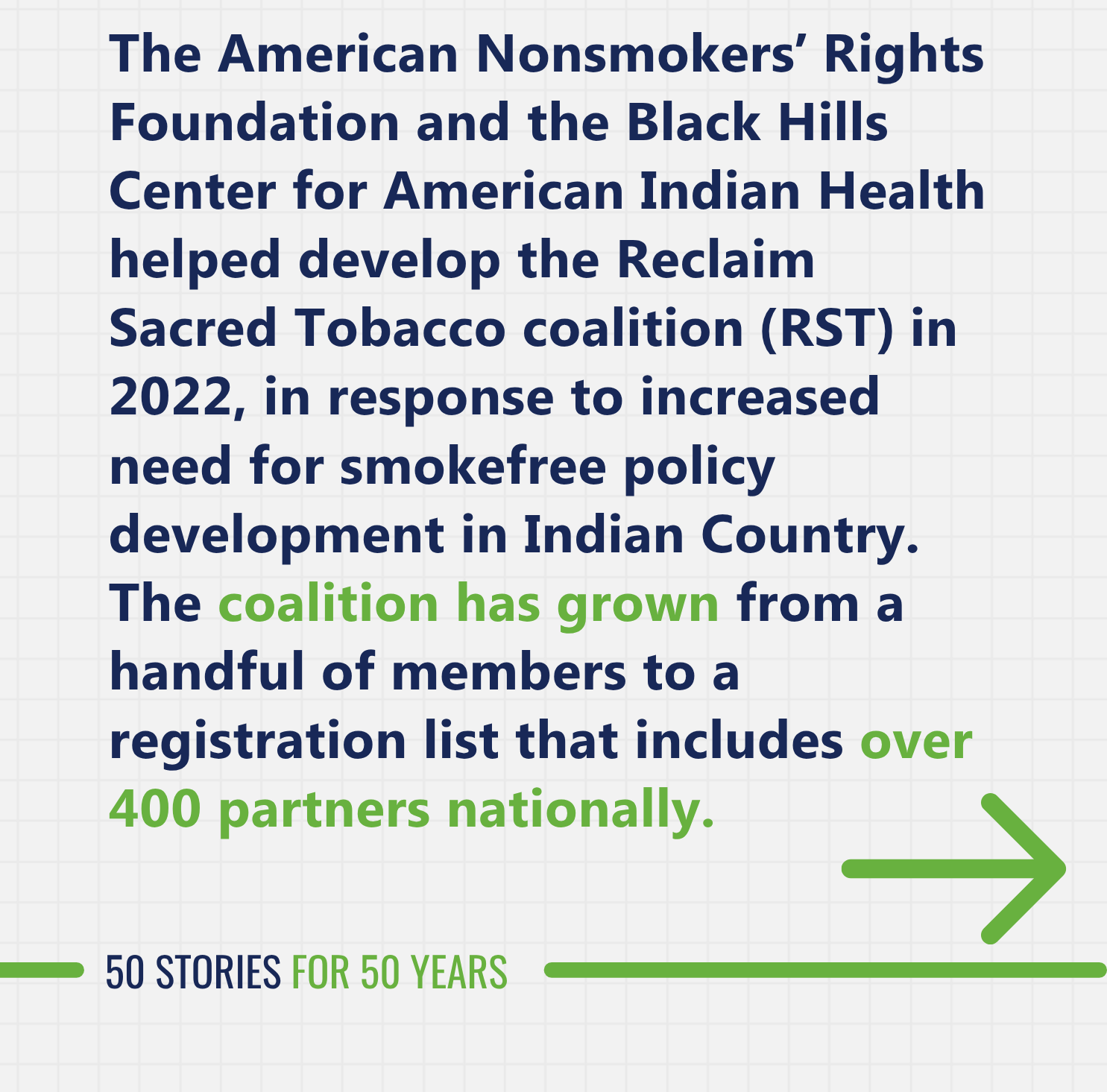
RST was developed in 2022 with the support of the ANR Foundation and the Black Hills Center for American Indian Health, co-founded by Clinton Isham in direct response to growing need for smokefree policy development in Indian Country. In just a few years, it has grown from a grassroots effort into a funded, coalition-driven movement with a national network of more than 400 partners. Coalition calls hosted online every other month draw an average of 40 participants and cover everything from traditional tobacco cultivation, to smokefree casino policy, to restoring Indigenous names to sacred sites.
Coalition calls have become spaces where cultural reclamation and public health policy are treated as the same project, not separate tracks. When Lavita Hill of the Eastern Band of Cherokee Indians joined an RST call in 2024, she spoke about her community’s successful campaign to make Harrah’s Cherokee Casino Resort smokefree and about the restoration of the traditional name Kuwohi to a sacred mountain within what is now Great Smoky Mountain National Park. Both were acts of sovereignty. Both belonged in the same conversation.
“A lot of times our campaigns are siloed,” Isham has said. “It seems like we’re working on these things individually as a tribal community. Something that Reclaim Sacred Tobacco is doing since our inception, we kind of share that responsibility. We bring everybody together.”
The result is something more durable than any single campaign. “Instead of it’s one Tribe working on this campaign, now it’s like you have the support from all these other Tribes — Tribes that have done the work already, Tribes in the process, Tribes that may have failed at passing policy. We’re all in this together.”
Smokefree Tribal Casinos
A significant part of Isham’s work with ANR Foundation has focused on Tribal casinos a space where the smokefree opportunity is large and the obstacles are real. Tribal casinos operate under Tribal sovereignty, meaning that state smokefree laws don’t apply to them. Every Tribe makes its own decision about a smoking policy. That is both a challenge and an opportunity: a challenge because there is no single lever to pull, and an opportunity because Tribes can act without waiting for state legislatures.
In 2015, fewer than five Tribal casinos in the United States were smokefree. Ho-Chunk Gaming Madison became a turning point when it implemented a 100% smokefree policy that year, weathered a modest short-term revenue dip, and then surpassed its own flagship site in Wisconsin Dells as the top revenue earner. That story, which Isham has shared at the Indian Gaming Association Tradeshow and Convention and on RST calls alike, has become a model for how to make the case to skeptical Tribal leadership.
The data reinforces it. Research consistently shows that casino patrons, even including smokers—prefer smokefree gambling environments, and that the number one factor in a patron’s decision to visit a casino is not the games, the payouts, or the proximity. It is whether the casino is smokefree and how clean it is.
Today, 169 Tribal gaming facilities are operating smokefree by their own sovereign policy. That shift, built one Tribal decision at a time, reflects years of work by advocates like Isham, who has appeared at national conferences, partnered with Tribal health departments, co-produced videos with Tribal community members, and built the trust that makes those conversations possible in the first place.
Healthier Tribes, Safer Spaces
As ANR marks 50 years of smokefree advocacy in 2026, Isham sees the work in Indian Country as connected to ANR’s longer arc. “When I think of ANR Foundation, I always think of the airlines that they helped go smokefree years ago,” he said. “It was such a big deal. And through that work, and through tons of other initiatives, there’s so much more that we can do, there’s so much more important wins like that to be done. Through our partnership with Reclaim Sacred Tobacco, we’re going to have a lot more of those wins, a lot more of those types of successes.”
RST is now planning its first in-person gathering, building out a Tribal Advisory Board, and developing resources that Tribes can use to run their own campaigns. The coalition’s direction reflects Isham’s foundational belief: that solutions for Tribal health cannot be imposed from the outside. They must rise from within.
What Clinton Isham and the Reclaim Sacred Tobacco Coalition are doing, in partnership with ANR Foundation, is the long work of undoing the harms of commercial tobacco, restoring tobacco to its sacred purpose, and building smokefree environments where Native people can live, work, and breathe, without commercial tobacco.
Clinton Isham is a citizen of the Lac du Flambeau Band of Lake Superior Chippewa Indians, a Tribal Relations Consultant with the ANR Foundation, and co-founder of the Reclaim Sacred Tobacco Coalition. Learn more about ANR Foundation’s work in Indian Country at smokefreegaps.org/sovereign-tribes. His story is part of our 50 Stories for 50 Years campaign.
Follow the campaign on Facebook and Instagram for story updates throughout 2026, and join the conversation using #ANR50.