
Keeping Zydeco Alive with Smokefree Air

“A longer life filled with music”
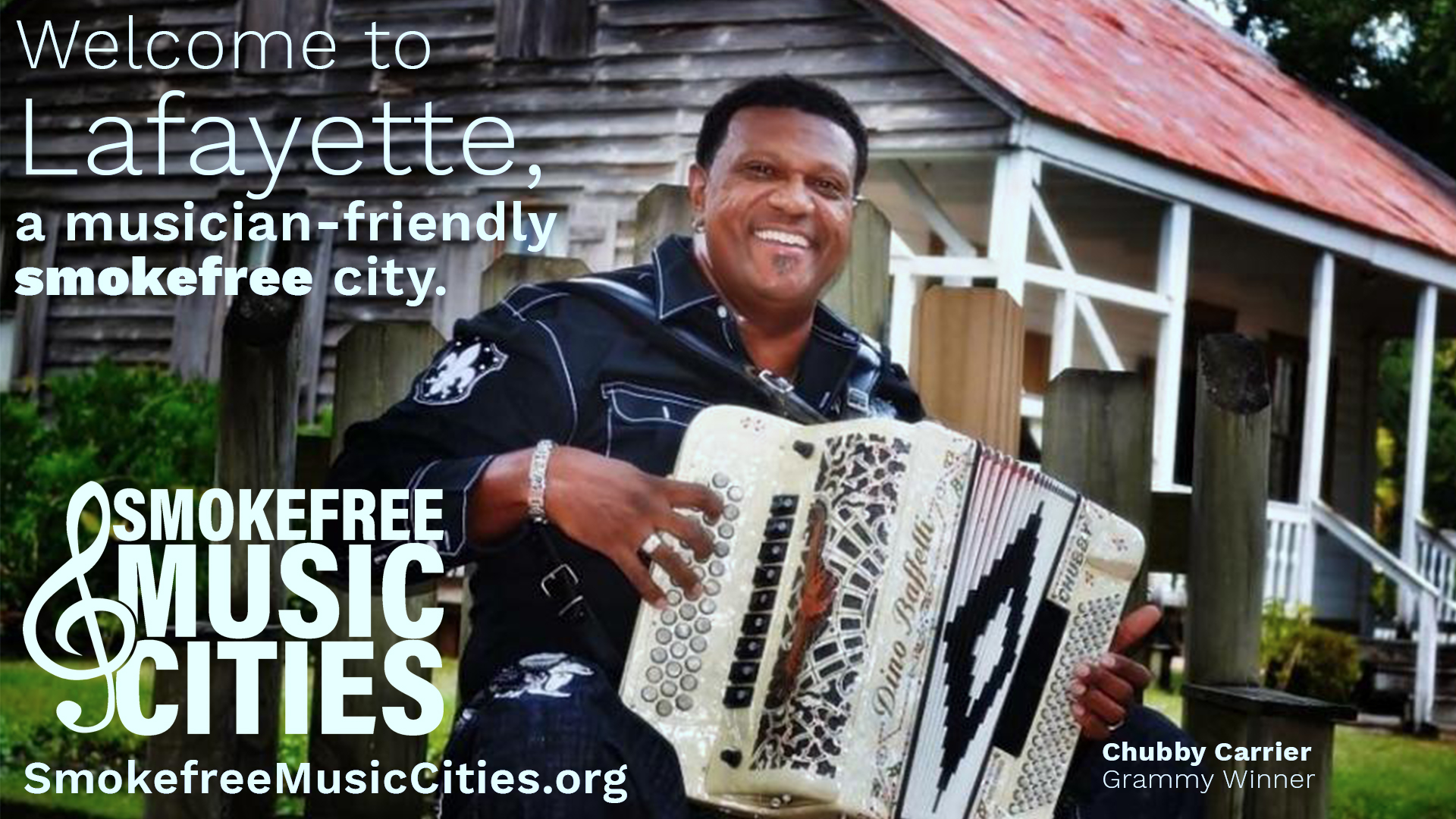
For Chubby Carrier, the Grammy-winning accordionist and frontman of the Bayou Swamp Band, his zydeco roots run deep. His grandfather and father played, and Chubby has spent his entire adult life playing zydeco, carrying a tradition that stretches back more than a century into the dance and music of south Louisiana.
He also watched that tradition cost his father his life.
Roy Carrier, a legend in zydeco music and the man who taught Chubby the accordion, spent decades performing in smoke-filled venues that were simply the reality of the working musician’s world. He died of lung cancer. For Chubby, the loss was not just personal; it was a warning. And it became the fuel for his advocacy to make sure other musicians didn’t have to make the same bargain his father had.
The Carriers are zydeco royalty, a multigenerational dynasty that helped shape what the genre sounds like today. Chubby began playing drums with his father’s band at age 12, picked up the accordion at 15, and by 17 was touring Europe. He’s played the New Orleans Jazz and Heritage Festival, the Chicago Blues Festival, and Montreux Jazz Fest in Switzerland. In 2011, his album Zydeco Junkie won the Grammy for Best Zydeco or Cajun Music Album. He was inducted into the Louisiana Music Hall of Fame that same year. The city of Lafayette, among others, gave him the keys to the city.
So, when Chubby Carrier showed up to advocate for smokefree venues, he wasn’t an outsider looking in. He was one of the most respected voices in Louisiana music. People listened.
“I want to leave a longer music legacy to my family and fans than my father, Zydeco Legend Roy Carrier, was able to leave to me,” Chubby has said. “He had to play in smoky places all of his career. And he suffered for it. Smokefree is a way to give me and my fans a longer life filled with music.”
Chubby was talking about legacy, about what zydeco music is worth and what it costs, about the difference between a tradition that survives and one that is slowly extinguished by cigarette smoke hanging in the air of every venue where it lives. He also knew he wasn’t alone in that loss. Mutual friends in the Lafayette music community, including musician David Egan, had died after years of exposure to secondhand smoke in performance spaces. The pattern was undeniable to anyone paying attention.
His reach extended to the broader Musicians for a Smokefree Louisiana coalition, where he served as a central spokesperson. Louisiana had passed a statewide smokefree workplace law in 2007, but it left bar and casino workers behind, exposed to secondhand smoke as a condition of employment. With ANR’s musicians and partners speaking up, cities began closing those gaps one at a time. Smokefree New Orleans passed in 2015. Smokefree Lafayette followed in 2017. Both campaigns were driven in significant part by the voices of working musicians.
In 2018, he helped kick off ANR Foundation’s Smokefree Music Cities initiative, which connected smokefree campaigns in music cities across the country and built a national framework for the kind of local advocacy that had already changed the air in New Orleans and Lafayette.
Protecting Culture with Public Health
Protecting musicians from secondhand smoke isn’t just a workers’ rights issue, it’s a cultural preservation issue. Zydeco, like the blues, like jazz, like all of Louisiana’s great musical traditions, is fragile in the way that living things are fragile. It depends on people who carry it, teach it, perform it night after night. When those people get sick, when they lose their voices, when they die too young, the music loses something it cannot easily recover.
Chubby Carrier was part of the coalition that made that momentum possible in Acadiana, and his partnership with ANR Foundation helped connect Louisiana’s work to ANR’s national movement, winning similar fights in Tennessee, Georgia, and beyond.
The progress Chubby helped make possible required many hands, many partners, and years of organizing, with repeated legislative attempts, and the willingness of people like Chubby to show up and speak publicly even when the political environment was difficult. The tobacco industry and gaming interests fought smokefree protections at every turn, and statewide legislation has remained elusive even as local victories accumulated.
Victories and Setbacks
Local victories were profound: New Orleans. Baton Rouge. Lafayette. Each city that went smokefree represented thousands of musicians and hospitality workers who could finally go to work without breathing toxic air. Each victory made the next one more achievable, building the kind of proof of concept that skeptical city councils could no longer dismiss.
But even with culture bearers like Chubby speaking out, there is still the shadow of Big Tobacco and the gaming industry in southern Louisiana. ANR fought hard to see Shreveport pass a comprehensive smokefree ordinance in 2020, only to have the city council roll back casino protections under pressure from the gaming industry. Sadly, casino workers, patrons and musicians in Shreveport are back to being exposed to toxic secondhand smoke. It’s a reminder that these wins are not always permanent.
The fight continues. But for the musicians playing in Lafayette and New Orleans tonight, the air is cleaner than it was when Chubby’s father, Roy Carrier was taking the stage.
Chubby said, “Smokefree is a way to give me and my fans a longer life filled with music.”
Chubby Carrier is a Grammy Award-winning zydeco musician, Louisiana Music Hall of Fame inductee, and longtime smokefree advocate. He served as a spokesman for Musicians for a Smokefree Louisiana and helped launch ANR Foundation’s Smokefree Music Cities initiative in 2018.
Follow us on Facebook and Instagram for ANR’s 50 story updates throughout 2026, and join the conversation using #ANR50