

WHY SAN FRANCISCO MUST REJECT INDOOR CANNABIS CAFÉS

San Francisco is experiencing a massive economic resurgence, with tech giants pouring billions of dollars into the local economy. The city is now livelier than ever. Foot traffic has spiked, population is increasing, and businesses are opening up across the city. But imagine walking into a sleek new San Francisco cafe, only to be greeted by a question we thought we buried decades ago—“Smoking or nonsmoking section?”
On July 14, the San Francisco Board of Supervisors enacted a regressive proposal on a 7-4 vote to permit indoor cannabis hospitality venues in the city, allowing retail spaces to transform into cafes and entertainment lounges where indoor smoking and vaping are completely legalized. This ordinance will effectively dismantle decades of hard-won public health progress, forcing a new generation of hospitality employees to sacrifice their health just to earn a paycheck.
This rollback comes at a poignant milestone for our movement. 2026 marks the 50th anniversary of Americans for Nonsmokers’ Rights (ANR), a national advocacy organization that began right here in the Bay area. In the 1970s, our early battles were fought over the simple right to breathe clean air in restaurants. By 1998, California made history by becoming the first state in the nation to completely eliminate smoking from all enclosed workplaces, including bars and restaurants. For decades, San Francisco in particular was celebrated as a global forerunner in health equity, consistently prioritizing the lives of its workforce over industry sky-is-falling myths about profit margins. Now, we are providing testimony and working alongside a dedicated local coalition to fight the exact same battle we won a generation ago. It is a stark reminder that our work to protect public health is never done.
Proponents of indoor cannabis lounges frequently rely on the flawed premise that cannabis smoke is somehow harmless compared to tobacco smoke. The scientific reality completely refutes this narrative. The 2024 U.S. Surgeon General’s Report, Eliminating Tobacco-Related Disease and Death: Addressing Disparities, explicitly warned that secondhand cannabis smoke contains many of the same toxic and cancer-causing chemicals found in tobacco smoke, with some harmful components found in even higher amounts.
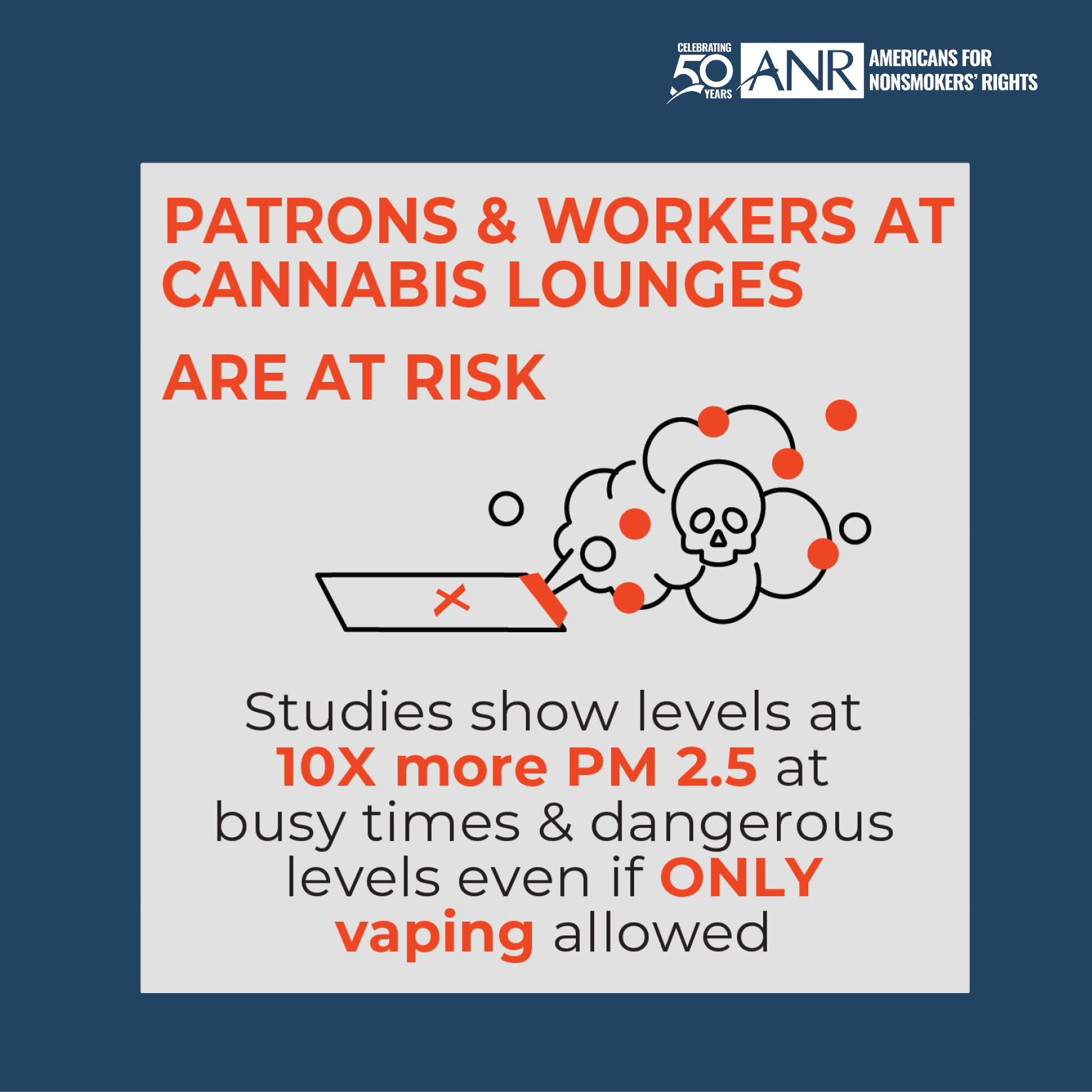
And indoors, these warnings are even worse—a landmark study from Stanford University found that smoking a single cannabis joint indoors produces an average fine particulate matter emission rate 3.5 times higher than a standard Marlboro tobacco cigarette. Air quality studies conducted by researchers at UCSF and UCLA inside existing cannabis lounges recorded hazardous, unhealthy levels of indoor air pollution during peak hours. Exposing staff to these extreme concentrations of toxic air directly increases their risk of asthma attacks, cardiovascular impairment, heart attacks, and stroke.
When confronted with these severe public health risks, cannabis business executives often point to ventilation as a solution. This is a page taken straight out of the tobacco industry’s outdated playbook. Air filtration systems can mask odors and clear visible smoke, but they cannot remove the microscopic, toxic carcinogens that cause irreparable damage — a fact verified by ASHRAE, the standard-setting body for the heating and ventilation industry. Research within San Francisco has already proven this: a 2022 UCSF study examined a San Francisco cannabis lounge and discovered that the installation of a specialized ventilation system resulted in a meager 12% decrease in toxic fine particulate matter. Air filtration is a marketing illusion, not a public health strategy.
Supporters of the cannabis cafe ordinance are focusing on misguided economic claims of helping struggling cannabis businesses and revitalizing San Francisco’s nightlife. San Francisco’s small businesses deserve complete support, but the city does not need to carve out exemptions that jeopardize worker safety in order to aid an already fast-growing economy. The industry’s claims that cannabis cafes will support cannabis retailers simply provides false economic hope in an oversaturated cannabis market. Furthermore, San Francisco’s nightlife is thriving, and no boost in vitality can be achieved by stripping away workplace health and safety protections from our essential hospitality workers.
For 50 years, ANR has worked at the grassroots level to ensure that every individual can breathe clean air. While California state law may grant local jurisdictions the authority to permit these cannabis cafés, it does not mandate them. We urge the Board of Supervisors to uphold San Francisco’s historic legacy of public health leadership that advocates have worked so hard to achieve. San Francisco’s lawmakers must not look backward. We must reject the false choice between economic growth and public health, reject this dangerous loophole, and keep San Francisco’s indoor workplaces 100% smokefree.
RESOURCES
Find all of ANRF’s marijuana and smokefree air resources at no-smoke.org/smokefree-threats/marijuana-smoke/. You can also access many more resources on our ProAccess online learning platform, including a four-part Marijuana and Smokefree Air learning module along with select scientific recordings from our monthly Office Hours. Learn more at: ProAccess.
The ANR Foundation is pleased to share its newest resource, Rolling Back Smokefree Protections: Expansion of Cannabis Smoking Lounges in California. This policy brief reviews the impact of the statewide laws that permit indoor smoking and vaping of cannabis products under certain conditions. Utilizing data from our U.S. Tobacco Related Laws Database© along with stories from colleagues and city partners, we document trends around what these policies look like, where they’ve been adopted, and whether communities allow the food and events components of the most recent statewide cannabis law. The brief includes several local examples and highlights materials and tools to help advocates be more prepared for rollback attempts.