
Founder, Fighter, Force for Clean Air
How Pete Hanauer Helped America Breathe

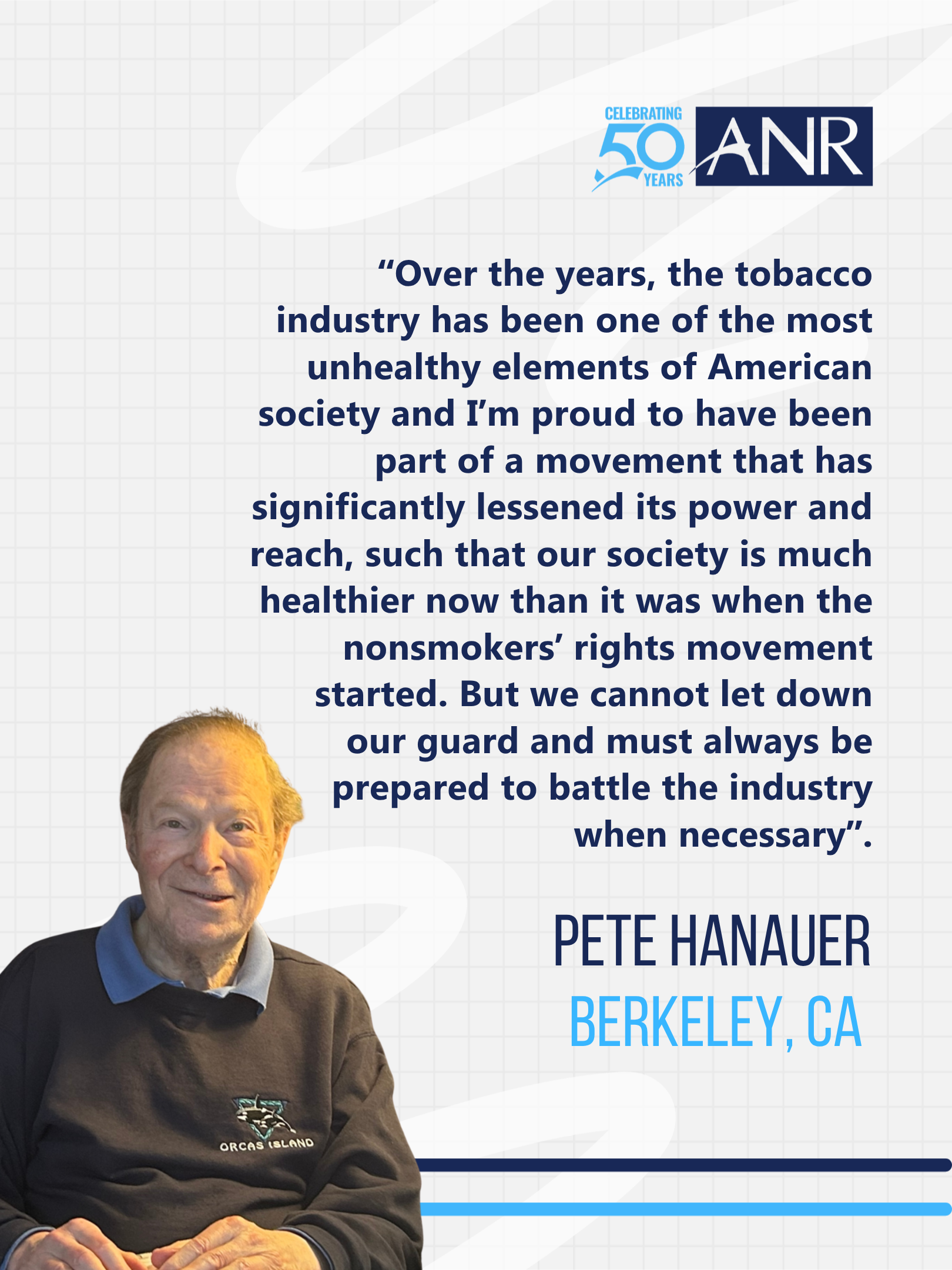
Pete Hanauer is the kind of public health hero who never sought the spotlight and didn’t necessarily set out to change the world. He, his wife Harriet, and a group of locals wanted to eat a meal without breathing cigarette smoke at a local restaurant. It seemed to them that they had the right to eat a meal without breathing in someone else’s smoke. Then there were people like Ann Williamson, she joined up because she was suffering from working in an office where people smoked all day long.
On March 1, 1976, this small group gathered at Tim Moder’s house in Berkeley with what must have seemed, to most of the world, like a radical idea: that indoor spaces, workplaces, restaurants, and public buildings ought to be places where no one had to breathe someone else’s smoke. At the time, smoking was at an all-time high. Office workers lit cigarettes at their desks. Movie theaters were filled with haze. Restaurants didn’t even have smoking sections yet, anyone could light up anywhere, anytime, right next to whoever was eating.
It Started With Secondhand Smoke
In the early 1970s, Pete Hanauer, a Columbia Law graduate, a legal editor at Bancroft Whitney in San Francisco, and a committed advocate for social justice, connected with a small local chapter of an organization called Group Against Smoking Pollution (GASP), and after his day job, on nights and weekends, he threw himself into building the nonsmoker’s rights movement. He co-founded the California chapter, which grew into Californians for Nonsmokers’ Rights (CNR), which eventually became Americans for Nonsmokers’ Rights (ANR). Pete was the founding President. He worked closely with Paul Loveday, another attorney who was instrumental in creating the legal framework for smokefree policy.
At the time there was little research on the health consequences of secondhand smoke exposure. The tobacco industry was all-powerful, flush with money, and deeply embedded in American culture, an icon that figured large. Anyone who grew up in the 70s remembers the massive ad campaigns, the Marlboro man, and in the 80s Joe Camel.
The founders of ANR didn’t have money, but they did have people power, clarity of purpose, and Pete Hanauer’s legal mind. Fifty years later, more than 13,000 state, county, and local laws restrict smoking across the United States. Adult smoking rates have fallen from 40–45% in the 1970s to roughly 9-10% today. Smokefree flights are so normal that travelers under forty have never known anything different. Millions of people are alive who might have died because of the effects of secondhand smoke and smoking, because Pete Hanauer and a small group of like-minded Californians decided that clean air was worth fighting for in 1976 and set in motion a movement that caused a sea change for America.
The Strategy That Changed Everything
Within a year of ANR’s founding, Pete and his colleagues achieved something historic: in 1977, Berkeley, California became the first community in the United States to pass a local clean indoor air ordinance. It was a modest law by today’s standards. It didn’t ban smoking everywhere. But it established the principle and more importantly, it proved the strategy. Pete had identified something that would become ANR’s defining insight and its most powerful competitive advantage against the tobacco industry: go local.
At the state and federal level, Big Tobacco’s money dominated. Lobbyists, campaign contributions, and industry-funded research crowded out public health voices at every turn. Pete co-authored two statewide California ballot initiatives in the late 1970s, and both were defeated—the tobacco industry spent $6 million alone to kill Proposition 5. It was a disappointing outcome. But Pete drew a lesson from it.
At the local level, the calculus was different. City councils and county boards were more accessible to ordinary citizens. Industry opposition, while still present, had less reach. A neighborhood activist with a compelling story could walk into a city council meeting and actually be heard. And when one city passed a law, neighboring cities took notice. The model could replicate itself, organically, across the country. ANR’s model ordinance and guidance rolled out across the country, as community after community, put smokefree policies in place, and America’s culture of smoking began to change.
Pete served as Treasurer and chief political strategist for ANR’s statewide campaigns, and when the tobacco industry attempted to repeal San Francisco’s landmark workplace smoking ordinance by referendum — placing it on the ballot as Proposition P — Pete led the successful defense. The industry threw money at it, but the ordinance survived.
By 1995, California became the first state in the nation to pass comprehensive statewide smokefree legislation, eliminating secondhand smoke from nearly all workplaces and indoor public spaces. By 1998, that protection extended to restaurants, bars, and gaming facilities. The local-first blueprint that Pete helped design had scaled all the way to Sacramento.
The Guidebook That Multiplied the Movement
As municipalities across California began passing smokefree ordinances, and as advocates in other states started calling CNR for help, Pete and his colleagues recognized a need: there had to be a way to transfer what they’d learned; the strategies, the talking points, the political tactics, the legal frameworks, to people starting from scratch in communities they’d never visited.
In 1986, Pete co-authored ANR’s answer to that need: “Legislative Approaches to a Smoke Free Society.” It was the movement’s first formal advocacy guidebook, a practical, replicable manual for communities that wanted to pass their own smokefree laws but didn’t know where to begin. It codified ten years of hard-won lessons: how to build coalitions, how to counter industry arguments, how to frame the issue for different audiences, how to navigate the political process at the local level. In the same year it was published, the U.S. Surgeon General released a landmark report on the health consequences of involuntary smoking, the first to make a definitive statement that simply separating smokers from nonsmokers in the same air space was not enough. 100% smokefree environments were the only real solution.
The Surgeon General’s science and ANR’s guidebook together ignited a wave of smokefree restaurant laws across the country. And four years later, on February 25, 1990, the prohibition on smoking on domestic flights took effect, a hard-won victory that ANR had helped make possible, working alongside tenacious flight attendants like Patty Young, who were willing to speak publicly about what it meant to spend their careers breathing toxic secondhand smoke. These flight attendants were dying of cancer, and the harms of secondhand smoke were real. For many Americans, that first smokefree flight was the first time they had ever experienced a completely smokefree indoor environment. It built public appetite for more. Pete’s guidebook was the manual that helped communities seize that moment. This book lives on today in ANR’s Clearing the Air guide, and in every training and convening ANR and ANRF produces.
The People Who Stood With Him
Pete never did this alone, and he was quick to say so. Two figures he singled out who have sadly passed away are Tim Moder, a local Berkeley advocate who offered up his home for the first gatherings of advocates. He had a printing machine and even printed ANR’s first materials. Pete also recalled Paul Loveday, an attorney whose work figured prominently in the building of the legal framework to support smokefree indoor air ordinances.
Two other persons who helped shape the smokefree movement were Dr. Stan Glantz and Sharon Eubanks. Pete spoke about both at his retirement-and they show the breadth of the coalition he helped build:
Pete met Stanton Glantz at a 1978 planning meeting for the statewide initiative campaign. Glantz showed up uninvited, introduced himself, and asked —as Pete’s told it— “the dumbest question I’ve ever heard.” Which was, “whether there was anything he could do to help.” The room erupted in laughter when Pete recounted it, because everyone present knew what “a little help” from Stan Glantz had amounted to: he became the foremost scientific authority on the cardiovascular effects of both first and secondhand smoke, was a key figure in the Cigarette Papers, a frequent and devastating expert witness against the tobacco industry, and eventually President of ANR for four years.
Sharon Eubanks was the Department of Justice attorney who led the federal RICO lawsuit against the major tobacco companies, the case that resulted in a federal judge declaring the industry had engaged in decades of fraud and racketeering. Pete said about her contribution: “Many in the tobacco control movement are disappointed that we didn’t get all the remedies we asked for. But Sharon’s work branded the tobacco industry as racketeers and it defined the tobacco industry forever as a duplicitous industry.”
The Cigarette Papers: Baring the Truth Behind the Smoking Industry
By the early 1990s, Pete had become a central figure in the national tobacco control movement as a trusted political strategist, a legal mind, a person whom colleagues knew they could call. That trust placed him at the center of one of the most consequential document disclosures in American public health history.
In May of 1994, confidential documents from tobacco company Brown & Williamson began arriving at the University of California, San Francisco addressed in part to Stan Glantz, under an anonymous pseudonym: “Mr. Butts,” a reference to the character in the comic strip Doonesbury. The documents, sent by whistleblower Merrell Williams Jr., contained something the tobacco industry had spent decades and billions of dollars to suppress: proof that thirty years earlier, the industry had known that nicotine was addictive and that smoking caused cancer. A proof that they had deliberately withheld that information from the public.
Pete had also previously helped his colleague, UCSF professor Stanton Glantz, bring another suppressed truth to the public: “Death in the West,“ a documentary that Philip Morris had legally silenced, which Pete and Stan helped get into public hands. Now, with the Brown & Williamson documents, the stakes were even higher.
Pete, Glantz, and several colleagues analyzed the leaked papers and co-authored “The Cigarette Papers,” a comprehensive exposé that journalists immediately recognized as, “the Pentagon Papers of tobacco.” The comparison was apt. Like the Pentagon Papers, this was a case of an institution of enormous power having systematically deceived the public on a matter of life and death. The truth came to light.
The tobacco industry fought back ferociously. Brown & Williamson threatened to sue any publishing house that printed the book, and one after another, publishers declined. The company stationed private investigators at the UCSF library to monitor every person who walked into the section housing the documents. Meanwhile, Congressman Henry Waxman of California read portions of the papers directly into the Congressional Record, putting them permanently in the public domain. Glantz housed them at the UCSF library, and posted them online, arguing successfully that they had become part of the public record. Eventually, the University of California Press published the book.
The firestorm that followed helped fuel the massive federal RICO lawsuit against the tobacco industry, led years later (as previously mentioned) by attorney Sharon Eubanks (currently ANR’s Board Chair). Pete described her work: “It’s not possible to overstate the importance of what Sharon did in bringing the successful federal lawsuit against the tobacco industry.“
The Database: A Different Kind of Dedication
After retiring from his position as a legal editor at Bancroft Whitney in 2001, Pete joined the staff of the ANR Foundation and began what would become more than sixteen years of quiet, essential, irreplaceable work. His title was Senior Policy Analyst. His job was to track, analyze, and catalog every smokefree law passed anywhere in the United States, feeding the results into what eventually became the ANR Foundation’s U.S. Tobacco Control Laws Database©, the most comprehensive resource of its kind in the country and a model for other public health law databases. ANR received new laws every week, and Pete analyzed every one, insisting on entering them into the database himself.
At his retirement celebration in January 2018, surrounded by family, ANR donors, board members, staff, and colleagues, Pete tried to explain why this work, so unglamorous compared to the courtroom battles and political campaigns of his earlier years, had given him such deep satisfaction.
“My principal work at ANR was analyzing tobacco control laws,” he said. “I would analyze a law and then enter it into our database. Every time I entered one, I got a fix. Who needs a nicotine fix when I could get a fix telling me that what we’d started out to do 40 some odd years ago was being replicated day after day after day, all across the country. And it is a great feeling to know that we were saving lives with every single law that passed.”
That is Pete Hanauer summed up. Not boasting, but the profound, daily satisfaction of knowing that the work of tobacco control was having an effect, that the movement he had been inspired to start because of a smoke-filled restaurant in Berkeley had rippled outward until it touched every corner of the country.
He also spoke that evening about what the larger arc meant to him. “I consider myself lucky indeed to have been part of a social movement that was so successful. When I started in 1974, there were 31 laws restricting smoking — and none related to workplaces, restaurants or bars.
Today there are more than 11,000 (in 2018, now in 2026 over 13,000) state, county, or local laws restricting smoking. Fifty-eight percent (in 2018, now in 2026 66.8%) of the U.S. population is covered with a comprehensive law, and a majority of states are now covered. It’s been a great thrill to see it happen over the years.”
What Pete Hanauer Helped Build
The numbers are impressive and large: adult smoking rates in the United States have fallen from 40–45% in the 1970s to approximately 9% today. 66.8% of the U.S. population now lives in a community protected by local or statewide smokefree workplace, restaurant, and bar laws. Every domestic flight is smokefree. Do you remember what it was like to travel in a smoky airplane? Today’s younger generations have benefitted from the healthy conditions indoors, having never experienced what it’s like to be in an enclosed space with clouds of cigarette smoke. The CDC credits smokefree laws directly for the dramatic decline in secondhand smoke exposure over the past three decades.
The United States spends approximately $225 billion each year treating smoking-related illness. Every law that passed, every ordinance Pete entered into the database, was a step toward reclaiming some of those dollars for prevention instead of suffering.
And yet the work isn’t finished. Today, 37.2% of American workers are still exposed to secondhand smoke in the workplace, most of them in casinos. The tobacco industry has morphed and expanded into e-cigarettes, vapor, pouches, heated nicotine products, and cannabis. New threats to smokefree protections are emerging every year with the advent of cigar bars and marijuana legalization. ANR’s smokefree laws map is no longer blue and grey, but a new color was introduced to reflect CO, CA, and MI; places where marijuana legalization has led to the reintroduction of indoor smoking. So ANR is still fighting, still going local, still tracking every law, still amplifying the voices of workers who haven’t yet been protected.
Pete closed his remarks at his retirement with a characteristic mix of pride and impatience. “I just hope it doesn’t take another 50 years to make sure that everyone can breathe clean air in workplaces and public places.”
Extraordinary Legacy
In our 50th anniversary reflection we describe how a half-century of advocacy had really been built on: “ordinary people doing extraordinary things—secretaries, law book editors, flight attendants, musicians, casino workers, and people who care about their community.”
Law book editors: certainly a nod to Pete, the man who spent his days editing legal volumes at Bancroft Whitney, and his evenings and weekends building a movement that changed the culture of smoking in the United States. Pete Hanauer received the American Lung Association’s Unsung Hero Award in 2002, presented to him by former U.S. Surgeon General C. Everett Koop, cementing his legacy of good works, and his powerful impact.
What Pete and his colleagues set in motion is written into the legal codes of thousands of American communities, encoded in a database he tended with daily devotion for years, carried forward by a movement he helped found and that continues to fight on.
The smokefree world that most Americans now take for granted in their offices, their restaurants, their airports, their flights, was not inevitable. The smokefree movement was built by advocates and attorneys and researchers and ordinary citizens who decided clean air was worth fighting for, that public health policies like smokefree indoor air are important means to protect people of all kinds, including a quiet man from Berkeley, California, who just wanted to breathe.
Americans for Nonsmokers’ Rights (ANR) is celebrating 50 years of advocacy in 2026. To learn more about ANR’s work and support the ongoing fight for smokefree air for all workers consider becoming a member today.