

August 2026: Message from the President and CEO


Berkeley, CA—As we mark 50 years of advocacy, I’m reminded of our humble yet powerful beginnings and the people who gathered to make change—citizens who organized to improve working conditions, advocating for “No Smoking” desks and nonsmoking sections in restaurants. The success of local grassroots advocacy launched from donors like you. Over time, we were fortunate to secure funding from state governments, national foundations, universities, and the federal government, but over the last two years, those funds have been completely eliminated or diverted away from public health.
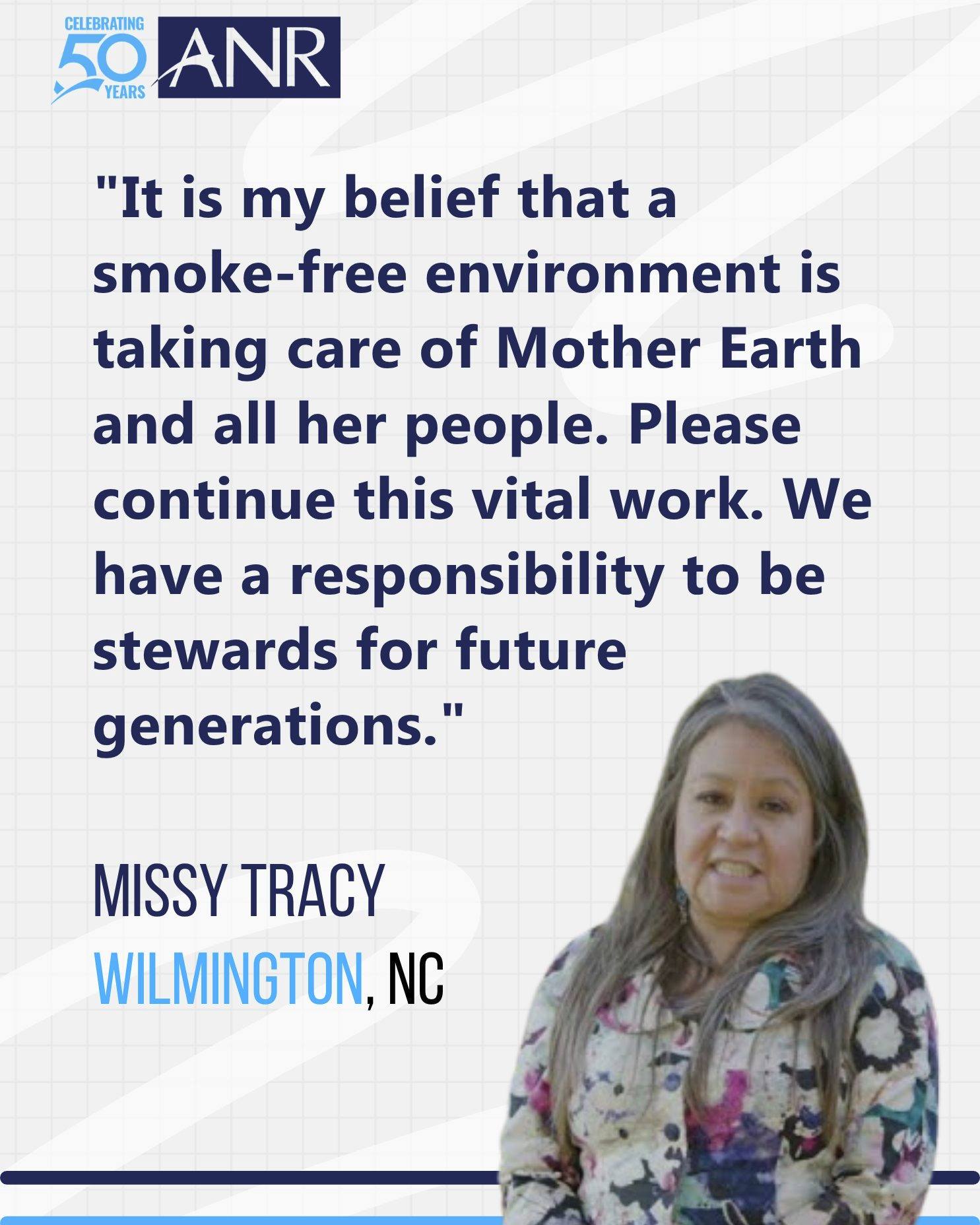
Concerned citizens have been the backbone of ANR throughout our history, and donor support is now vital to our survival.
ANR has witnessed the evolution of the nonsmokers’ rights movement and weathered unfavorable political environments in the past; however, the current atmosphere is particularly dangerous. We have lost the expertise of talented professionals as a result of budget cuts, and many of our citizen advocates have been silenced or are afraid of losing their jobs.
Most foundational resources for commercial tobacco control have been eliminated, including state and national media campaigns that educated the public about the hazards of smoking and secondhand smoke, and the benefits of quitting smoking and vaping. These campaigns also provided a counterbalance to social media ads and social media influencers who promote smoking, vaping, and alternative nicotine products like Zyn nicotine pouches. Big Tobacco has been taking advantage of the dismantling of federal departments, lack of oversight and regulations, and the elimination of material and financial resources for tobacco prevention programs. They have used these changes to push an agenda designed to renormalize smoking and use of nicotine products, protecting profits while threatening public health, democracy, and individuals’ ability to advocate for smokefree protections.
While federal and state governments pull back on funding for public health policies and policy action, cities are at the forefront, moving forward on smokefree policies. That local momentum is both rare and fragile, which is precisely why this moment calls for investment, not retreat. Grassroots coalition building at the local level is the core of ANR’s history and where the fight has returned 50 years later.
The state of smokefree progress, threats, and victories:
Worker-led coalitions advocating for smokefree casinos and music venues are gaining traction with elected officials. However, progress is never guaranteed. ANR is continually called upon to help communities defend recent policy victories and oppose ongoing efforts to weaken existing protections. These efforts include proposals to create new exemptions allowing indoor smoking of cigars and cannabis, which could ultimately open the door to the return of cigarette smoking and secondhand smoke exposure in indoor public spaces.
Right now, the cities of San Francisco and Knoxville are actively moving smokefree policies forward, while Detroit is fighting attacks on their existing smokefree airport policy [see update]. Advocates and coalitions in these cities are hard at work to expand smokefree protections. They are being met with an eerily similar talk track that reeks of Big Tobacco interference. Communities and partners are counting on ANR to show up and fight with them.
One might not think there would be many parallels between the San Francisco effort to make outdoor bar patios smokefree and Knoxville, Tennessee’s move to close loopholes that allow smoking indoors at age-restricted venues—but when Team ANR began to compare notes from public hearings, the opposition arguments resurrected from the Tobacco Industry’s old playbook echo from coast to coast.
In both cities, common themes include alleged economic harms (which have been proven untrue), invoking freedom of choice (ignoring how it limits others’ choice to not breathe carcinogens), claiming adults can make their own decisions (undermining efforts of other adults who are trying to quit), and claiming all workers know what they are getting into (even in places where there are limited employment opportunities).
Opponents also use strategies to delay a decision, for example by requesting a study committee despite numerous available studies, or extending the implementation of the law, claiming businesses need more time to prepare, when in reality, this just gives the Tobacco Industry time to weaken or repeal the law. The most egregious tactic has been suppressing citizen engagement by denying public comment. This is happening now on the proposed cigar smoking venue at Detroit Metropolitan Wayne County Airport. Despite a strong coalition that shows up prepared, follows the rules, and is backed by public opinion polls that clearly state that the community is against bringing back indoor smoking, democracy is being thwarted because public comment is not being allowed.
The good news: ANR is THE go-to trusted resource.
We have the expertise and community connections to secure our goals despite the relentless challenges (and shenanigans) from the opposition. Our deep institutional knowledge about industry interference means we know how to respond:
We know to watch the legislative process for special committee schedules and riders to bills that are fast tracking—the preferred industry methods that happen just outside the normal legislative process in order to prevent public input and backlash from the trusted public health community.
We have strong relationships with elected officials, workers, and community members who share information when opponents reach out with compromise proposals.
We continue to work on building more power from diverse partners to counter the opposition and to encourage and prepare workers, family members, business owners, and community members to tell their stories, which often has more power and sway than facts and figures.
No one is better suited than ANR to build movements against corporate giants that are better funded, have more legal resources, and possess greater power with lawmakers.
ANR has 50 years of scrappy yet effective organizing and fighting, of commitment to communities and people, and of being at the top of the movement as a trusted, go-to resource that our field cannot imagine or envision a world without.
Resources, read more:
San Francisco Allowing Marijuana Smoking Indoors
The Case Against Big Tobacco: 20 Years Later
###
Americans for Nonsmokers’ Rights (ANR), sister organization to the ANR Foundation, is a member-supported, non-profit advocacy group that has been working for 50 years to protect everyone’s right to breathe nontoxic air in workplaces and public places, from offices and airplanes to restaurants, bars, and casinos. ANR has continuously shined a light on the tobacco industry’s interference with sound and life-saving public health measures and has successfully protected 62.8% of the population with local or statewide smokefree workplace, restaurant, and bar laws. ANR aims to create healthy communities by closing remaining gaps in smokefree protections for workers in all workplaces, including bars, music venues, casinos, and hotels. For more information, please visit nonsmokersrights.org and smokefreecasinos.org.
See a timeline of ANR’s 50 Years of Work